F216
F216

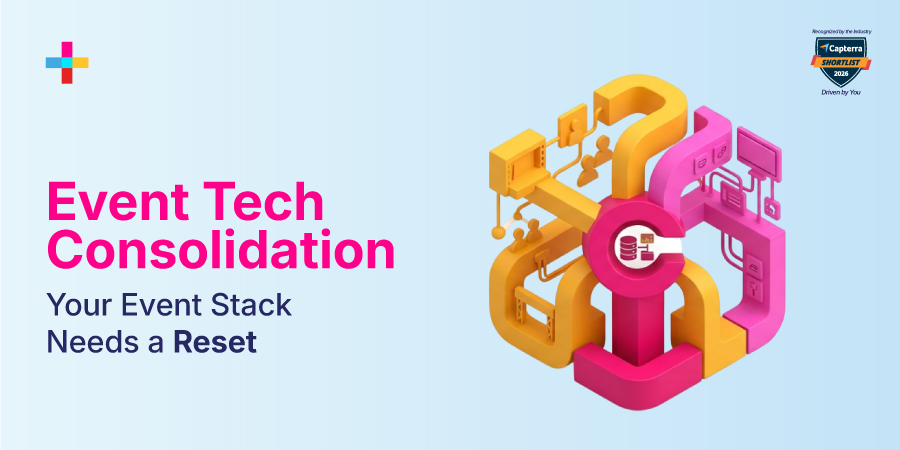

In event management, tool consolidation means replacing a stack of disconnected tools with one system that actually runs the event end to end. Not just technically connected, but operationally aligned.
Most event tech stacks don’t fail when they’re built. They fail when teams start using them. Data stops matching, analytics and reports take longer than they should, and decisions get made on whatever information is available in the moment. What looked complete during setup turns into constant coordination during execution.
The problem is that these tools, coming from different setups, cannot work as one system. As events expand into hybrid formats, recurring programs, and sponsor-driven models, that gap gets harder to ignore. Data lives in different places, reporting tells different stories, and visibility drops exactly when it’s needed most.
This is where tool consolidation for event management becomes a practical shift, not a technical upgrade. This article breaks down what’s causing the problem, when consolidation starts to make sense, and how a unified system changes the way events are run.
What Is Event Tech Consolidation?
Event tech consolidation is the move from managing multiple disconnected tools to running events on a single system that handles registration for the events, its marketing, engagement, analytics, and on-site operations together.
Instead of pushing data between platforms, teams operate inside one environment where information stays connected and is updated in real time. This is what turns event tech from a set of tools into a working system.
Why Do Event Tech Stacks Become Fragmented Over Time?
Event tech stacks rarely start fragmented. They become fragmented as teams keep adding tools to solve immediate problems.
Tool accumulation across the event lifecycle
Different event planning software are introduced at each stage of the event lifecycle.
Each new tool solves something in the moment. A campaign tool for marketing. A registration system for operations. An event app for engagement.
What starts as a practical decision becomes a pattern. Every new requirement leads to another tool, not a better system. This is how fragmented event tech environments are created over time.
Vendor-led feature expansion without system alignment
Vendors keep introducing new features, which often leads teams to adopt additional tools. These decisions are usually made without evaluating how, or whether the new systems should integrate into the overall event infrastructure.
On paper, it looks like progress. In practice, teams end up managing more pieces of the same system.
Short-term tool adoption without long-term architecture planning
Event teams are usually working against timelines. When something needs to get done, the priority is to fix it fast, not design a system.
This leads to tools being selected based on what they can do right now, not how they’ll fit later. Over time, those decisions stack up, and the system starts to feel inconsistent.
Integration-first strategies that create long-term complexity
When tools don’t fit together, integrations feel like the obvious fix. Connect this tool to that one and move forward.
It works for a while. But as more connections get added, the system becomes harder to manage. Data moves between tools, but keeping everything in sync starts to take more effort than expected.
Fragmentation doesn’t happen all at once. It builds quietly, until the system becomes harder to manage than the event itself.
What Problems Do Fragmented Event Tech Stacks Create?
Fragmented event tech shows up as gaps in execution, reporting, and decision-making, not just system inefficiencies.
Duplicate attendee identities across systems impacting lead attribution
Attendee data across multiple systems leads to duplicate records. This affects lead attribution and reduces the accuracy of engagement tracking.
Broken data flow across registration, marketing, and engagement
Disconnected systems disrupt consistent data flow across the event lifecycle. As a result, marketing engagement data isn’t directly connected to registration outcomes or on-site participation.
Delayed operational decision-making due to fragmented data
Fragmented systems mean event teams rely on multiple dashboards to assess performance. This delays decision-making during live events and reduces attendee responsiveness.
Lack of system-wide visibility during live events
Accessing real-time insights across sessions, attendees, and their engagement requires a centralized system. Without this control, personalization becomes limited during critical event phases.
Tool Consolidation vs Event Software Integrations
Tool consolidation reduces the number of tools and centralizes the workflow into one system. But most event teams integrate multiple tools across event lifecycle for basic data exchange. In the long run, it only manages fragmentation but does not remove it.
As the system scales, integrations introduce additional dependencies, increasing maintenance effort, and reducing data consistency.
Let’s understand the differences between tool consolidation and event software integration.
|
Evaluation Criteria |
Event Software Integrations |
Tool Consolidation for Event Management |
|
Core approach |
Connects multiple tools through APIs or middleware |
Reduces number of tools by centralizing workflows into one system |
|
System architecture |
Multiple independent systems linked together |
Single, unified event infrastructure |
|
Data model |
Separate data models across platforms |
One shared attendee data model |
|
Data flow |
Synchronized between systems (often delayed) |
Continuous, real-time within one system |
|
Operational dependency |
High dependency on integrations and external tools |
Minimal dependency on external systems |
|
Maintenance effort |
Requires ongoing API monitoring, troubleshooting, and updates |
Reduced maintenance due to fewer systems |
|
Scalability |
Complexity increases as more tools and integrations are added |
Scales through standardized workflows within one system |
|
Reporting accuracy |
Inconsistent due to multiple data sources |
Consistent reporting from a single data source |
|
Cost structure |
Hidden costs in integration maintenance and duplicate tools |
Lower total cost through system consolidation |
|
Risk level |
Higher risk of data mismatch and system failure |
Lower risk due to unified architecture |
|
Use case |
Short-term solution to connect existing tools |
Long-term strategy to eliminate fragmentation |
|
Outcome |
Manages fragmentation |
Eliminates fragmentation |
The difference is not connection. It’s control.
What Is the Hidden Cost of Fragmented Event Tech
The hidden cost of fragmented event tech is not limited to software pricing. It manifests in delays during operations, inconsistent reporting, and financial leakage across the event lifecycle.
Organizations often underestimate these costs because they are distributed across systems, teams, and workflows rather than appearing as a single budget line item.
Cost of integration maintenance
Fragmented event stacks heavily rely on software integrations to maintain cross-system data flow. These integrations require API monitoring, middleware configuration, developer support, continuous maintenance, and troubleshooting when systems fail.
Research shows that organizations manage an average of 300+ applications, yet only a fraction are fully integrated. This creates dependency on technical resources to maintain system connectivity.
Cost of delayed decision-making
Disconnected systems have slow access to event data. During live events, delays in accessing insights reduce the ability to optimize sessions and personalize attendee journey.
Analysis from McKinsey & Company indicates that organizations operating with fragmented data environments experience slower decision cycles due to limited real-time visibility.
Cost of data inconsistency on revenue reporting
Fragmented systems store attendee and engagement data across multiple platforms, leading to inconsistencies in reporting. Incorrect attribution impacts sponsor reporting, marketing performance analysis, and overall event ROI measurement.
Research from Deloitte highlights that organizations without a unified data architecture struggle to maintain a reliable single source of truth, directly affecting reporting accuracy.
Operational overhead cost
Manual data reconciliation increases workload. Event teams spend significant time reconciling data across systems, validating attendee records, and aligning reports instead of focusing on event execution.
Vendor and contract cost duplication
Using multiple tools from different vendors to introduce overlapping features resulting in redundant subscriptions and misaligned contract cycles.
Organizations frequently buy SaaS tools, completely unaware that they are buying the same features from two different vendors. In the end, they end up questioning why their total software spend is high, but improvement is still low.
Risks of Fragmented Event Systems Created Over Time
Fragmented event systems create financial, governance, and reporting risks that extend beyond inefficiency. Organizations lose control over data access, accuracy, and accountability when data is distributed across multiple platforms. They create data delays resulting in less exposure, inaccurate reporting, and low ROI. These risks are not isolated and compound across the event lifecycle.
Increases financial risks from inaccurate event reporting
Leadership decisions based on incomplete data increase financial risk. An event team running on inconsistent data affects revenue reporting and financial forecasting.
Complicates governance challenges across multiple event tools
Multiple systems create gaps in data ownership, access control, and compliance. This complicates governance across event operations.
Increases audit and compliance risks
Fragmented data environments make it difficult to maintain audit trails. This affects compliance with internal and external reporting requirements.
Leakage of revenue due to incomplete attendee tracking
Incomplete tracking of attendee insights results in missed engagement data. These missed opportunities impact sponsorship value and long-term ROI opportunities.
What Are the Signs Your Event Tech Stack Needs Consolidation
Fragmented event tech does not fail visibly. It indicates breakdown in data continuity, workflow efficiency, and reporting accuracy.
These indications are measurable. When multiple indications appear together, they show that your event tech stack is not running as a unified system anymore.
Multiple attendee records without a unified identity
Duplicate attendee records are emerging across registration, marketing, sessions, content interactions and engagement platforms.
Manual CSV-based data movement between systems
Teams are relying on manual processes to synchronize attendee data across system.
Marketing and registration systems not synchronized
Your event teams are unable to measure the accurate conversion performance.
On-site systems disconnected from CRM and reporting
Your on-site check-in and attendance tracking systems operate independently, preventing real-time data synchronization during events.
Inconsistent dashboards across event tools
Your teams are using multiple dashboards to generate separate reports where conflicting data doesn’t create a unified view.
If your events require manual data movement, or you need to maintain multiple attendee records, and rely on separate dashboards for reporting, then your technology stack is fragmented, and you need tool consolidation for your event tech.
What Are the Benefits of Tool Consolidation for Event Management
Tool consolidation for event management brings event data and workflows into a single, connected system. Instead of coordinating between disconnected tools, this single data system eliminates fragmentation, enabling consistent data accuracy, event execution, reporting, supporting faster, more confident decision-making.
Single source of truth for attendee data
Fragmented systems store attendee data across registration, marketing, and engagement platforms. Event tool consolidation brings this data into a single system with a consistent identifier.
Faster execution across the event lifecycle
When event workflows operate within a single system, data does not need to be transferred between platforms. This removes delays caused by manual synchronization and integration dependencies.
Accurate and unified event ROI measurement
Consolidated systems connect event marketing activity, attendee behavior, and revenue data within one reporting framework. This allows organizations to track performance across the full event lifecycle.
Reduced vendor dependency and operational overhead
Multiple tools requires coordination across number of vendors, contract management, and support systems. Consolidation reduces the number of systems involved in event execution.
Scalable event infrastructure for multi-event programs
A consolidated event platform standardizes workflows across events. Teams can replicate event structures without rebuilding technology configurations for each program.
When Should You Not Consolidate Event Tech Tools?
Tool consolidation is not always the right move. In some cases, pushing for it too early creates more disruption than value.
- When your events are simple and low scale and workflows are limited and data does not need to move across systems, multiple tools can still work.
- When your current setup is stable and tools already work together with consistent data and reliable reporting, consolidation may not add immediate value.
- When your team is not ready for change and lacks time for process alignment and training, consolidation can slow execution.
- When you are in the middle of active events and systems are already in use, switching can introduce risk and disrupt operations.
What Does a Consolidated Event Tech Stack Look Like in Practice
A consolidated event tech stack brings all event workflows into a single system where data and processes are connected. Instead of managing separate tools, event teams operate within a connected system where data flows continuously.
This structure removes dependency on external integrations and creates a consistent data layer across registration, engagement, on-site operations, and reporting.
Registration and attendee data as a single entry point
In a consolidated event stack, registration acts as the primary data source. Every attendee record is created and maintained within a unified data model, which is then used across marketing, engagement, and reporting workflows.
Marketing execution connected to live attendee data
Marketing workflows operate directly on registration and engagement data within the same system. Audience segmentation, communication, and campaign tracking are based on real-time attendee activity.
Engagement layer integrated into the core system
Session participation, networking interactions, and in-event engagement are captured within the same platform. This eliminates the need to merge engagement data from external tools.
On-site operations connected to the same data environment
On-site badges and check-in systems along with attendance tracking operate within the same infrastructure. Data from on-site interactions updates the central system in real time.
Unified analytics across the full event lifecycle
All event data, including registration, marketing, engagement, and attendance, is processed within a single reporting framework. This eliminates data silos and enables consistent performance measurement.
Event Tech Consolidation Checklist
Event tech consolidation should be evaluated as a system-level decision, not a tool replacement exercise. This checklist helps organizations assess fragmentation, quantify impact, and define consolidation readiness.
Assess current event tech environment
Document all tools used across the event lifecycle, including registration, marketing, engagement, on-site operations, and analytics.
Identify where multiple tools perform overlapping functions and where systems operate independently.
Identify data fragmentation and system gaps
Evaluate how attendee data moves across systems. Determine whether a consistent attendee identity exists across registration, marketing, and engagement platforms.
Quantify operational overhead and manual effort
Measure the time spent on manual data reconciliation, CSV exports, and cross-platform coordination for each event.
Calculate integration and maintenance cost
Assess the cost of maintaining integrations, including API management, middleware tools, and developer support.
Research from Gartner forecasts that worldwide software spending will exceed US$6 Trillion in 2026, an increase of 9.8% from 2025.
Evaluate reporting accuracy and data consistency
Compare reports generated from different systems. Identify inconsistencies in attendee data, engagement metrics, and revenue attribution.
Review vendor contracts and cost overlap
Analyze licensing costs, vendor contracts, and renewal cycles.
Research from Gartner indicates that organizations can lose up to 30% of their SaaS spend due to duplicate tools, underutilized features, and ineffective license management.
How do you Consolidate Event Management Tools Without Disrupting Operations?
Tool consolidation for event management should be executed as a controlled system transition. The objective is to replace fragmented workflows without interrupting live event execution, data continuity, or reporting accuracy.
A structured, phased approach reduces operational risk while maintaining system stability.
Step 1: Audit the existing event tech environment
Step 2: Map workflows across the event lifecycle
Step 3: Define unified data architecture
Step 4: Evaluate consolidated event platform capabilities
Step 5: Execute phased technology consolidation
Step 6: Train teams and monitor operational performance
When Should You Switch to a Consolidated Event Platform
Tool consolidation for event management becomes necessary when fragmented systems begin to impact operational execution, reporting accuracy, and cost control. These conditions are not subjective. They appear as measurable breakdowns in workflows and data continuity.
The following are five signs that you need a consolidated event tech platform.
When integration cost exceeds system value
Organizations often rely on integrations to connect multiple tools. Over time, the cost of maintaining these integrations increases through API management, middleware tools, and developer support.
When data consistency cannot be maintained across systems
When attendee data, engagement metrics, and revenue reporting exist across multiple platforms, inconsistencies begin to appear across dashboards.
When operational workflows depend on manual coordination
If event teams rely on manual processes such as CSV exports, data reconciliation, or cross-platform updates, the system is no longer operating efficiently.
When reporting accuracy impacts financial decisions
Leadership teams rely on event data for revenue attribution, sponsor reporting, and performance evaluation. Fragmented systems reduce confidence in these metrics.
When event scale exceeds system capability
As organizations expand into multi-event programs, hybrid formats, and global operations, fragmented systems cannot scale efficiently.
What to Look for in a Consolidated Event Platform
The consolidated event platform must replace fragmented tools with a unified system while maintaining data continuity, operational control, and accurate reporting.
Evaluation should focus on how the platform supports unified workflows rather than isolated features.
- End-to-end event lifecycle support
- Unified attendee data model
- Built-in analytics and reporting
- Scalability across event formats
- Reduced reliance on third-party integrations
Conclusion
Events no longer operate as isolated workflows. They function as integrated data systems where every stage impacts execution and reporting outcomes.
Fragmented event tech breaks this system by distributing data, slowing decisions, and reducing reporting reliability. These gaps compound across events, affecting both operational performance and financial visibility.
Tool consolidation for event management restores system control by aligning data, workflows, and reporting within a single environment.
At that point, event teams are no longer managing tools; they are managing a unified event system.
Book a demo to see how Eventcombo enables event tech consolidation.